
Do you feel as though one leg is shorter than the other? Perhaps you’ve noticed that you stand slightly lopsided, you regularly experience pain in your lower back or hip, or you’ve been told that you have a leg-length discrepancy.
In chiropractic practice, we often find that, whilst there is no anatomical leg length discrepancy, there is a functional leg length discrepancy.
What is a leg length discrepancy?
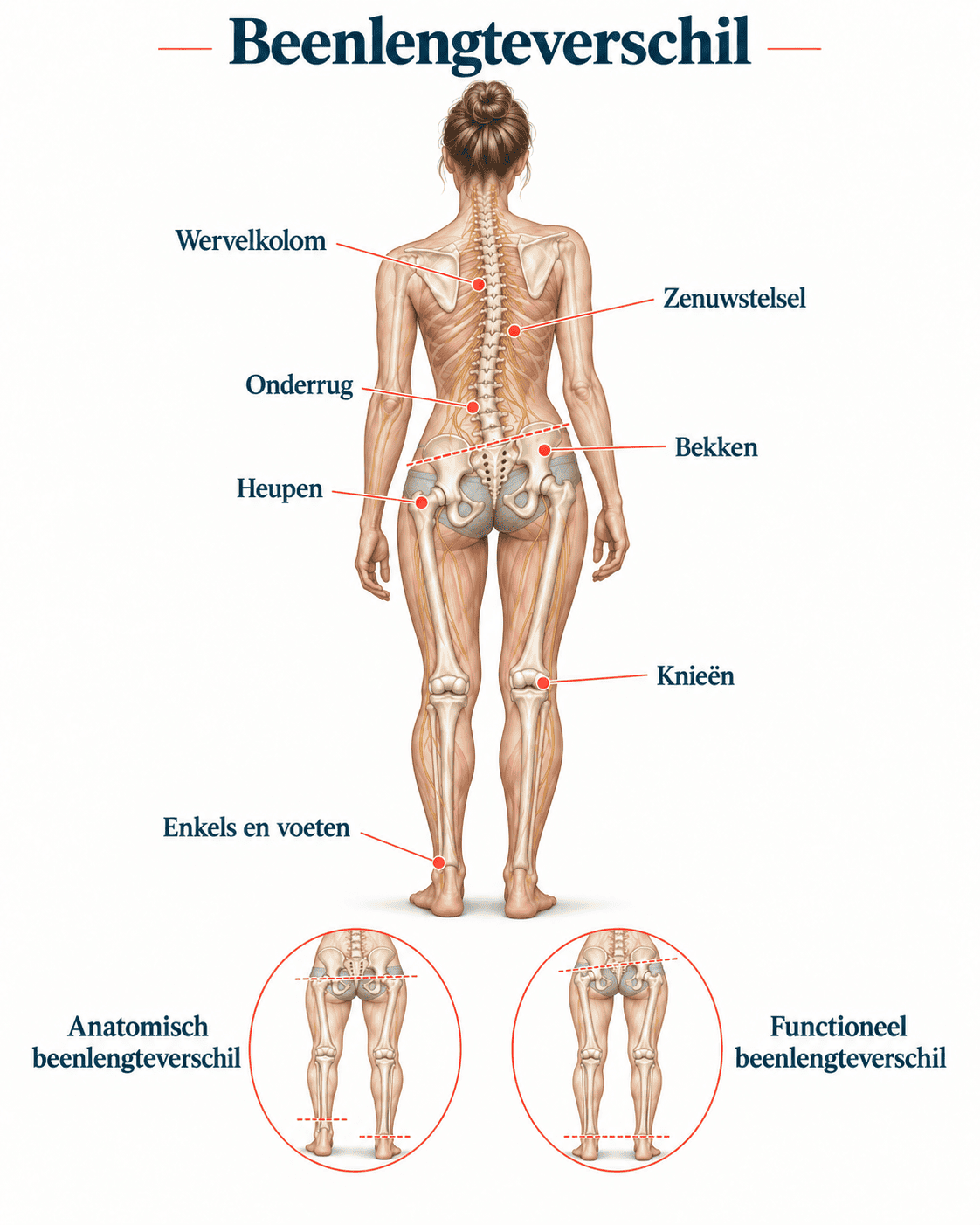
A leg-length discrepancy is when one leg is, or appears to be, longer than the other. We distinguish between two types:
Anatomical leg length discrepancy: There is actually a difference in the length of the bones in both legs. This may, for example, be congenital or result from a fracture or surgery.
Functional leg length discrepancy: The length of the bones does not necessarily have to differ, but factors relating to posture and movement can make it appear as though one leg is shorter than the other.
A chiropractor can help you identify what might be causing your leg length discrepancy.

Can a misaligned pelvis make one leg appear shorter?
The position and movement of the pelvis can affect the alignment of the legs. As a result, a difference may appear to be visible during a physical examination, although this does not necessarily mean that one leg is anatomically shorter.
Simply looking at the position of the feet or legs is therefore not enough to determine an anatomical leg length discrepancy.
A chiropractic examination assesses the functioning of the entire kinetic chain: from the feet and legs, through the hips and pelvis, right up to the spine. This is important because these areas influence one another. See below for an illustration of how this might look.
An asymmetrical posture resulting from an imbalance can make the legs appear different during a physical examination, even though there is no actual difference in bone length. It is the latter that we see most frequently in our practice
What symptoms can be associated with a leg length discrepancy?
A difference in leg length does not always cause symptoms. Our bodies are often able to cope well with minor differences by adapting. For example, the pelvis and spine may start to move differently to compensate for the difference.
The nervous system plays an important role in this. The nervous system controls our muscles and movements and helps the body to constantly adapt to our posture and the strain placed on it.
Sometimes it becomes more difficult for the body to cope with these differences, and symptoms may arise.
In chiropractic, we therefore look not only at the difference in leg length, but also at how the body functions as a whole. We look at the legs, the pelvis and the spine, how they move together and how the nervous system is involved in controlling them.
If symptoms do occur, they may, for example, be related to:
- the lower back;
- the pelvis;
- the hips;
- the knees;
- the ankles and feet.
The presence of a leg-length discrepancy does not automatically mean that this is the cause of back, pelvic or hip problems.
That is why it is important to look not only at the difference between the two legs, but also at the symptoms, movement and other possible factors.

Can chiropractic treatment help with a leg length discrepancy?
A chiropractor cannot correct an anatomical leg-length discrepancy by making the shorter leg longer. The length of the bones does not change as a result of chiropractic treatment.
For someone experiencing symptoms, our chiropractors from Den Bosch It is, however, important to investigate how the musculoskeletal system functions. This may involve examining, amongst other things, the lower back, the pelvis, the hips and the way in which a person moves.
In the case of a functional difference, the focus is therefore not on altering bone length, but on investigating factors relating to posture, movement and joint function that may be linked to the symptoms.
How do you know if you really have a leg-length discrepancy?
During a physical examination, signs of asymmetry may be found. However, this does not necessarily mean that there is an actual difference in bone length.
Where it is important to accurately determine an anatomical leg length discrepancy, further medical investigations may be required.
This may be relevant, for example, where a clear anatomical difference is suspected or where symptoms persist.

When is it advisable to have a check-up?
Do you regularly experience pain in your lower back, pelvis or hips, and do you feel as though you’re standing crooked or that one leg is shorter than the other?
In that case, research can help us to better understand what is going on.
The aim is not just to establish whether there is a visible difference, but above all to determine where that difference comes from and whether it could be a factor in your symptoms.
Based on the findings, it can then be discussed which approach is appropriate and whether further investigation or referral is required.


